| |
Knave
of Hearts
Color/B&W
141 p. Case only. Twin Palms, 1999 ($60.00)
This
is Lyon's major new work, many years in the making, publishing for
the first time his extensive use of photomontage, and reproduced
gorgeously by Twin Palms. Probably his most beautiful book.
"Claiming the same credibility for his personal images as for his
more conventional documentary pictures, he has made some of his
most political and most moving work to date."
Nan Goldin
"Doing Life", Artforum, Sept. 1995
"Photographer Lyon has created a photosensitive autobiography formed
of photos, and narrative text. The combined effort takes hold and
transforms the project into a kind of documentary analysis of the
pleasures of seeing and adventure without loss to it's surprising
intimacy. Powerful."
Strand Review
"an
autobiography in words and montages from one of the preeminent documentary
artists of our generation..... he helped into being the profound
changes wrought by the early, heroic civil rights movement, (Lyon
was the first staff photographer for SNCC), and the recognition
of the outsider and social outcast as an individual worthy of honest
attention"
Richard Gordon for Hungryminds.com
"I
was inspired, moved, delighted, brought to reach, and sometimes
overwhelmed traveling through the encapsulated journey of your life,
shown and told so beautifully."
Jennifer Durant
Available directly from Twin Palms, Post Office Box 10229, Sante
Fe, New Mexico, 87505, 800-797 -0680 (www.twinpalms.com),
Also A Photographers Place, NYC (212-966-2356), Edwynn Houk Gallery
(212-750-7070), A Gallery of Fine Photography (504-568-1313)
Knave
of Hearts Review
BY STEPHEN LONGMIRE
Originally published in DoubleTake Magazine, Fall 2000
In the mid-1990s, nearly twenty years after his parents died and
their house in New York City was sold, photographer Danny Lyon returned
to his childhood home as it was being sold again. As if in a dream,
he found relics of his own tenancy still inside. “ Upstairs
inside a walk-in closet was a pile of my earliest prints, which
I had mounted on black mat boards in 1962. The porcelain tub I had
bathed in as a child had been removed from the third floor and put
in the basement. In the tub were a couple of large plastic garbage
bags filled with books, many of which I had used in college.”
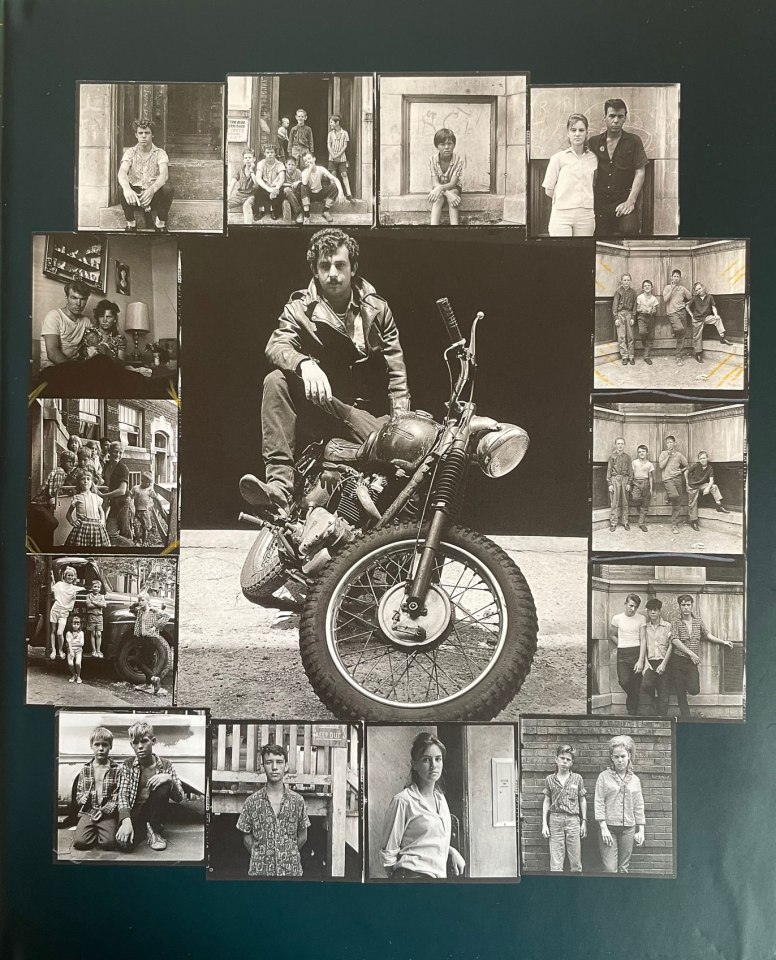
So begins Knave of Hearts, Lyon’s new memoir, which combines
text and collages--or montages, as the occasional filmmaker prefers
to call them--of his own photographs. The message is clear enough:
this book came out of the same time warp that allowed him to reenter
his childhood home. The house had become a time capsule for him,
filled with the smaller time capsules of his earliest photographs
and thoughts. In Lyon’s montages, his father’s photographic
archive is interspersed with his own, illustrating how our parents’
memories become an annex to our own.
Since college, Lyon has photographed in the public arena, often
for political cause, however personal it may have seemed, while
his father photographed strictly for personal reasons. To the younger
Lyon, all of these photographs are snapshots now, crystallized memories
showing the chance occurrences that have made his life meaningful.
His father’s memories fill out the blank spaces in his own.
With these photographs, the most recent of which show his own children,
Lyon pieces his life together like a jigsaw puzzle. Knave of Hearts
shows what photographs can mean to their creator, which is seldom
what they mean to others. Instead of the family of man, this is
one man’s family, a closetful for his descendants to discover—those
he knows, and those he doesn’t.
He observes his grandmother’s likeness to his own daughter,
now a grown woman. He looks on both of them with a father’s
tenderness and mourns the relatives who died before he could know
them. “They all look at me as if I was in the room with them,”
he writes, “as if I was making the photograph.” This
is the paradox Roland Barthes observes in his book Camera Lucida
when, studying Alexander Gardner’s photograph of a doomed
young man, he muses, “He is dead and he is going to die.”
The photograph remains in the present tense, as photographs always
do, long after its subject had vanished into the past. Lyon raises
the dead by imagining he has photographed them himself. He watches
over his grandmother, and she watches over him.
Snapshots typically mean everything to someone, and very little
to anyone else. It’s not easy to make snapshots that appeal
to a broad audience, but that’s how Lyon made his name in
the sixties. His photographs of the civil rights movement, collected
in The Movement(1964) and Memories of the Southern Civil Rights
Movement(1992), remain vital first-person documents of their time.
By Lyon has never been satisfied being a photojournalist. Knave
of Hearts attempts to reintegrate these and other projects into
the ongoing narrative of his life. “As the years turned into
decades,” he explains “I came to believe that by combining
[my photographs] and bringing in elements of color and details of
place and time, I could make something more evocative than any single
picture.”
Lyon’s work has always been about making outsiders part of
his family. In his introduction to The Bikeriders (1968; reissued
by Twin Palms Press in 1997), his celebrated portrait of the Outlaws,
a motorcycle racing club he briefly joined in Chicago, Lyon describes
his photography as “a personal record.” The propaganda
photographs he made for the Student Nonviolent Coordinating Committee
in the early years of the civil rights movement were also about
crossing line and taking sides.
Disenchanted with mainstream coverage of the movement and of the
phenomenon of the sixties, Lyon attempted “a new kind of photojournalism”
that made no pretense to objectivity or political neutrality. “Participatory
journalism,” as George Plimpton called it, required joining
up, occupying your subject’s position. “The most unsafe
place to be,” Lyon argues in Knave of Hearts, “whether
people are using rocks or bullets, is between the lines. You must
choose a side, if for no other reason than to have a firm spot on
which to stand and a moment’s peace to focus.” Photographing
helped him take his stand and enlarged his experience. “As
a child I had been afraid of so many things,” he recalls,
“but as soon as I held a camera in my hand, I began to expose
myself to the very things that were foreign to me and that I had
always feared.”
Previously unpublished outtakes from The Bikeriders and its two
“sequels” –The Destruction of Lower Manhattan(1969)
and Conversations with the Dead(1971)—accompany Lyon’s
pithy accounts of these projects in Knave of Hearts. Together, the
three early books form a loosely linked study of American machismo,
at once sympathetic and unsparingly critical. The Bikeriders commemorates
a risky form of lower-class white rebellion; the demolition men
in The Destruction of Lower Manhattan are seen tearing down block
after block of historic New York to clear room for a World Trade
Center that was unlikely to benefit them; Conversations with the
Dead depicts predominately white prisoners behind The Walls, the
oldest prison run by the Texas Department of Corrections, and includes
prison records and letters in which Lyon’s newfound friends
describe their experiences “inside.” In Knave of Hearts,
Lyon writes of his preoccupation with demolition derbies in the
late 1980s: “The whole thing seemed so wonderfully American,
almost a parody of our civilization going down in ruins.”
He works with his heart on his sleeve and his tongue in his cheek.
Jailed in 1966 after the antiwar march on the Pentagon, Lyon shared
a cell with “a young man in a serape, his gentle, dreamy eyes
glowing as if he were far away. ‘Do you think we’ll
have a revolution?’ he kept asking, as if saying it could
make it true…a revolution in Berkeley, a revolution in Forest
Hills? I asked myself, how could that happen? ‘Do you think
we’ll have a revolution?’ he asked once again. He was
talking to himself. Then he said, ‘We’ve already had
a revolution.’” At first it seems a bitter irony, like
so much in Lyon’s work. Then it becomes clear the young man
in Latin American garb is right. America had its revolution, but
the victory is still being won.
|
|